Essay · April 2026
Why large companies fail, and how to avoid it
An essay on why hierarchy distorts, why bureaucracy is a symptom, and what AI changes about the math of organizations.
When I worked at Formula 1 as an engineer, every decision came back to a single number. Lap time. Every component on the car contributed a vector of force, and every vector had to point in a direction that reduced lap time. A part producing downforce in the wrong place was worse than no part at all. A tiny misalignment at the front of the floor cost you tenths at the rear. The job of the engineering organization, hundreds of people across departments, was to make sure that thousands of small decisions summed to a force pointing the right way.
Companies work the same way. An organization is a collection of vectors. There is one big vector at the top, the company's true direction toward whatever its money machine actually is. Every person inside the company is a small vector (Individual contributors aka microvectors) of their own. Company performance is the sum of those vectors. The job of leadership is not to set a goal and let middle management handle it. It is to keep every small vector aligned with the big one.
The reason this is hard, and the reason most companies eventually fail at it, is leverage. The hierarchy is a lever, and it runs in two directions at once. Going down, it amplifies. Coming back up, it concentrates.
The Lever Problem
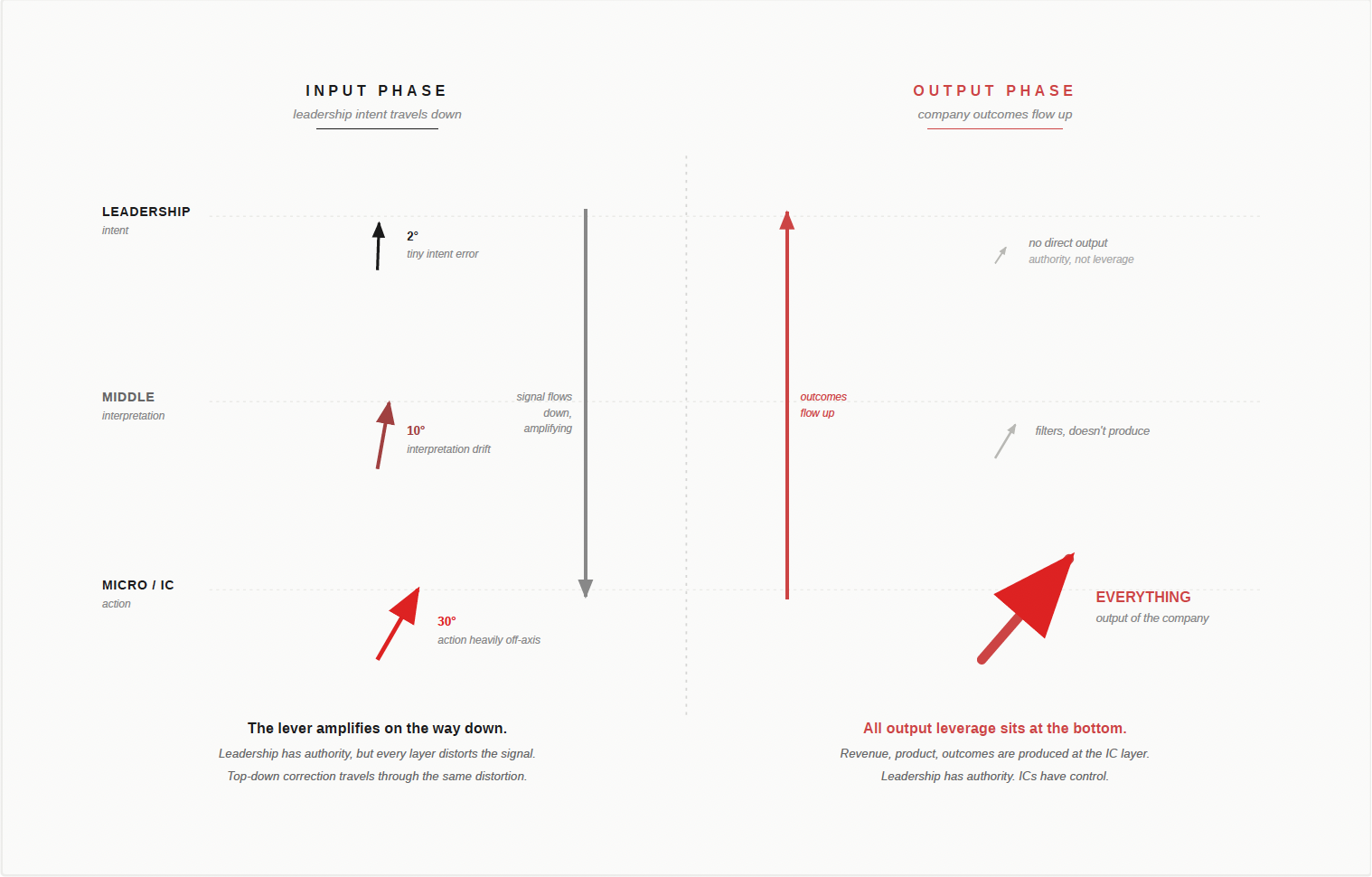
Start at the top. Leadership sets a direction, and that direction has to travel through every layer between the CEO and the people doing the actual work. Each person it passes through is a lever. Even when a middle manager is fully aligned, a tiny angular deviation in their personal reading of priorities gets amplified by the influence they have over the people below them. Two degrees of misalignment at the C-suite becomes ten degrees two layers down, and thirty by the time it reaches the IC. The signal distorts further at every step.
This is not malicious. It almost never is. A middle manager genuinely believes they are aligned and pushes hard on what they think is the right priority. The harder they push while subtly off-axis, the worse the damage. The very thing that makes a manager good at their job, the energy, the conviction, the willingness to drive a team, is the same thing that turns a small misalignment into a fatal one. A passive manager does no harm. An engaged manager pointing two degrees off the right vector is the most expensive person in the building.
The intuitive fix is to push harder from the top. Send a clearer memo. Run another offsite. Restate the strategy. None of this works, because the same lever that distorted the original signal distorts the correction. You cannot fix lever-amplified misalignment by sending more signal through the same lever. You only get more amplified noise.
Now flip the direction and look at how outputs flow back up. Revenue, product quality, customer experience, every measurable thing the company actually produces, is generated at the IC layer. Leadership does not write the code, close the deal, ship the unit, or answer the support ticket. Middle managers do not either. They route, schedule, prioritize, and filter. The actual output of the company is the sum of what the ICs do every day.
So on the way down, the lever amplifies, and leadership has authority but a distorted signal. On the way up, the lever inverts. All of the output leverage now sits at the IC layer, because that is where everything the company actually produces gets made. The layers above contribute nothing direct. Leadership has authority. ICs have control.
This is the asymmetry of impact that kills companies. Top-down direction is hard to send cleanly. Bottom-up reality is what determines outcomes. A 30-degree drift at the IC layer, set in motion by a 2-degree miss at the top, becomes the company's actual trajectory. Not what leadership intended. What ICs actually did.
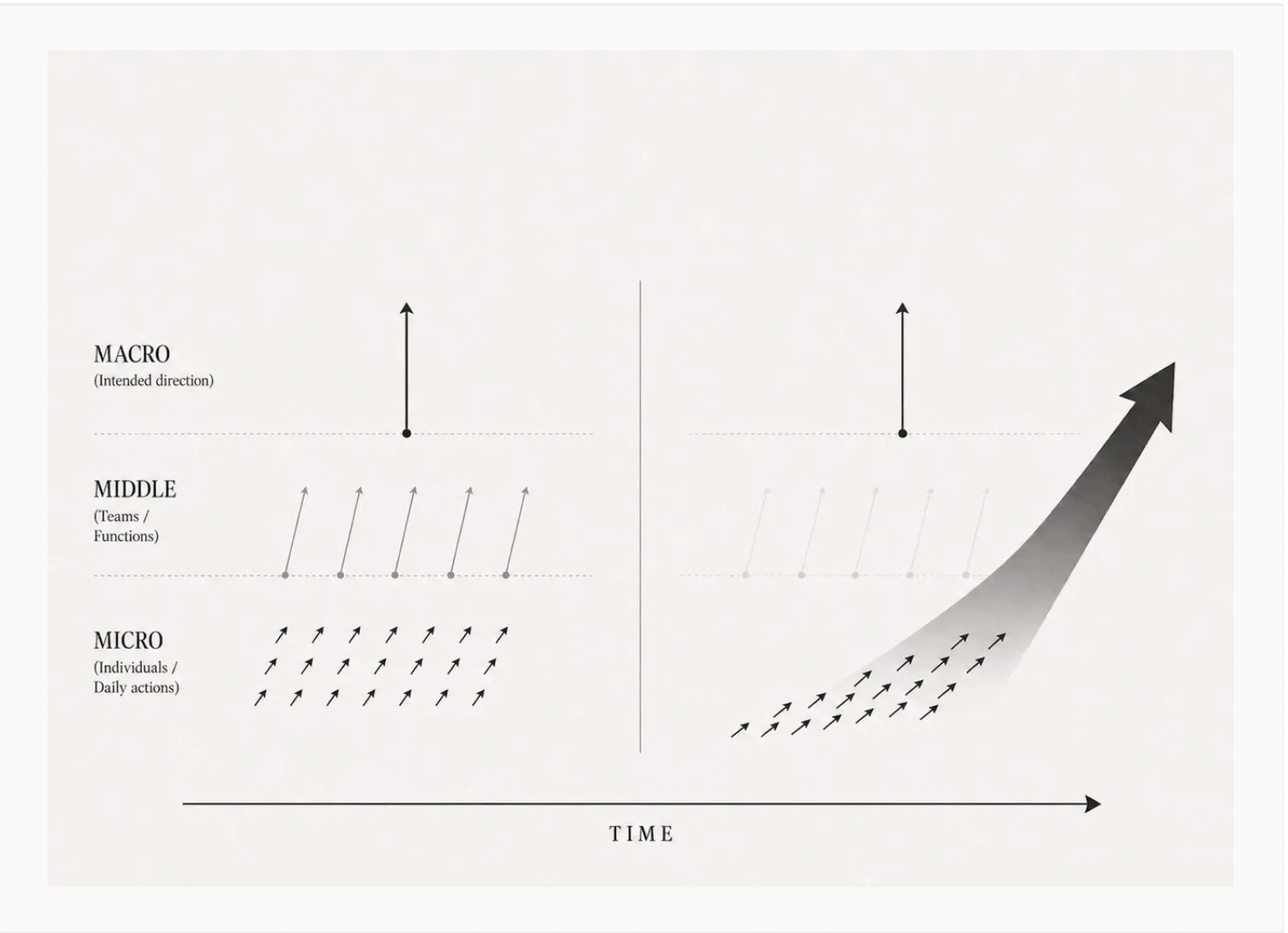
Once that drift is in motion, the company starts pointing in a direction that is not the money machine. Revenue softens. To correct course you need resources, which is exactly what drifting from the money machine takes away from you. This is a death spiral. It is hard to recover from, and the recovery requires resources you no longer have.
Bureaucracy is the visible symptom. People complain about meetings, about decisions taking too long, about politics. None of that is the disease. The disease is the asymmetry. Authority flows down through a lever that distorts. Output leverage flows up and concentrates at the bottom, where leadership cannot reach it. You can fire the bureaucrats and the asymmetry stays. You can rewrite the org chart and it stays. The hierarchy was built around it.
The Bandwidth Constraint
The reason hierarchies exist in the first place is a bandwidth problem. No leader can hold full context on hundreds of people doing hundreds of different things. Memory, attention, and time forced organizations to compress reality into layers: work broke into smaller units, information was summarized upward, and decisions were pushed back down. You can see the same pattern across history. Roman legions relied on centurions to make command work at the unit level. Prussia turned coordination and planning into a professional General Staff system. In the 1850s, American railroads made the same problem corporate: Daniel McCallum's New York and Erie Railroad plan, drawn with George Henshaw, became one of the first known modern organizational charts. Different eras, same constraint: once an organization exceeded one mind's bandwidth, it created intermediate layers to preserve coordination.
Hierarchy was always a workaround. It was the least bad solution to a constraint nobody had any way of breaking. Companies accepted lever amplification as the price of being able to operate above a certain size. They tried to dampen it with shared values, OKRs, all-hands meetings, town halls, rituals. None of it removed the underlying physics. Information still had to travel through people, and people are levers, and levers amplify.
Most flat-org experiment of the last two decades has run into the same wall. Each was an attempt to remove the lever problem without removing the bandwidth limit. They worked at small scale, then bent back into hierarchy as headcount grew, because nothing else could carry the weight that managers were carrying. The bandwidth limit was real. Until now, no technology had ever come close to relaxing it.
What AI Changes
AI removes the bandwidth limit. That is the entire shift, and it is bigger than people give it credit for.
A single leader or a small team of highly value and result aligned group, given the right tooling, can now hold real-time context on every individual contributor in the company. Code commits, Slack threads, calendar, email, design files, customer conversations, sales notes, build pipelines. All of it can be ingested, condensed, and held in a continuously updated model of what is actually happening on the ground. The AI is not a manager. It does not make decisions. It does not get a vote. It is a context layer that lets the human at the top stay close enough to every IC to align them directly, without a lever in between.
A second force compounds this. AI also reduces the number of people needed per task. Work that used to require a team of ten now gets done by one strong IC with the right tools. So the number of vectors a leader needs to track is falling at the same time their capacity to track each one is rising. Two curves bending in the same direction at the same time. This has never happened before in organizational history.
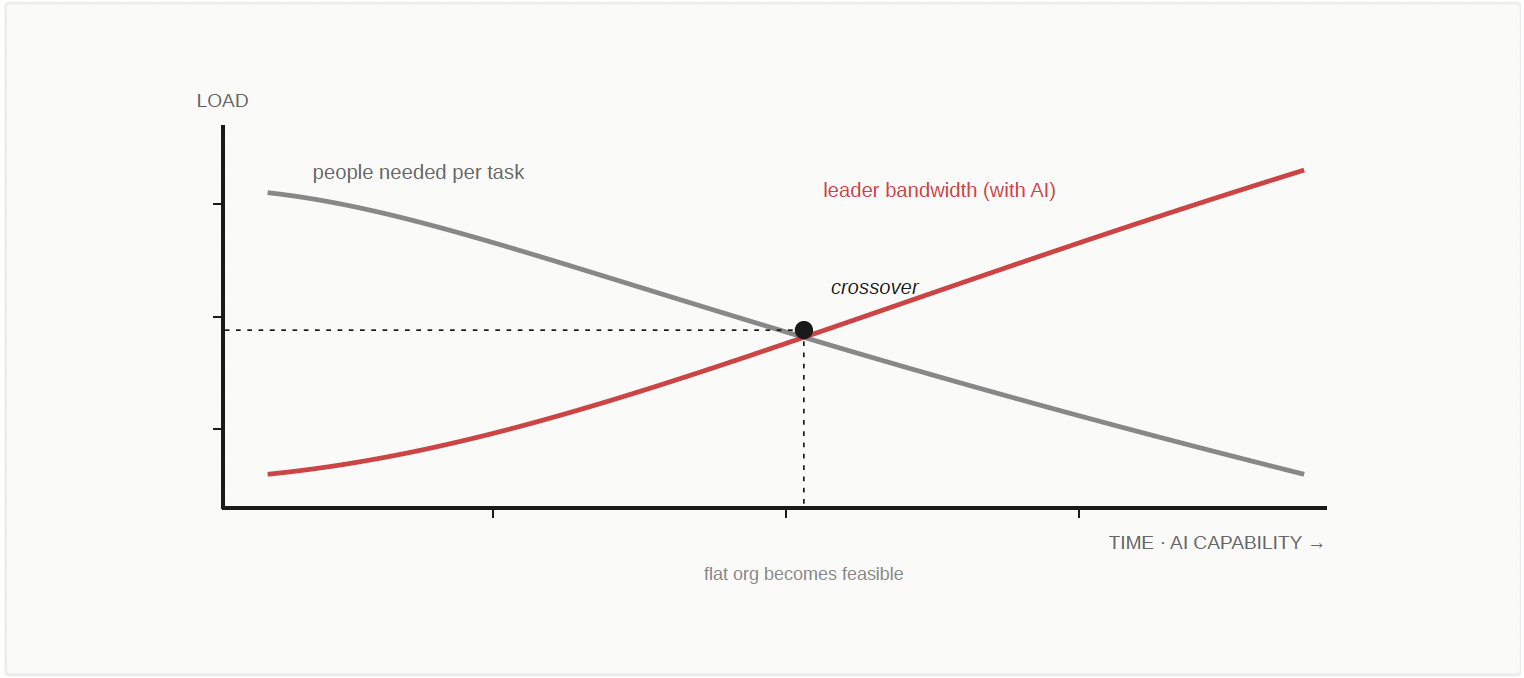
The combined effect is that the historical reason for middle management is dissolving. A flat, directly aligned organization is now operationally feasible at scales that previously required hierarchy.
What It Looks Like
You stop hiring middle managers. You hire agentic and smart ICs and you start with the few people who can hold the vector at the top, such as your co-founders or best team members. The top has to be tighter than usual, four or five people so aligned that any of them can speak with any IC and produce the same correction. They spend more time with each other, not less. Daily rituals, long working sessions, no formal walls between strategy and execution. When the top is one mind, every conversation an IC has with any of them reinforces the same direction.
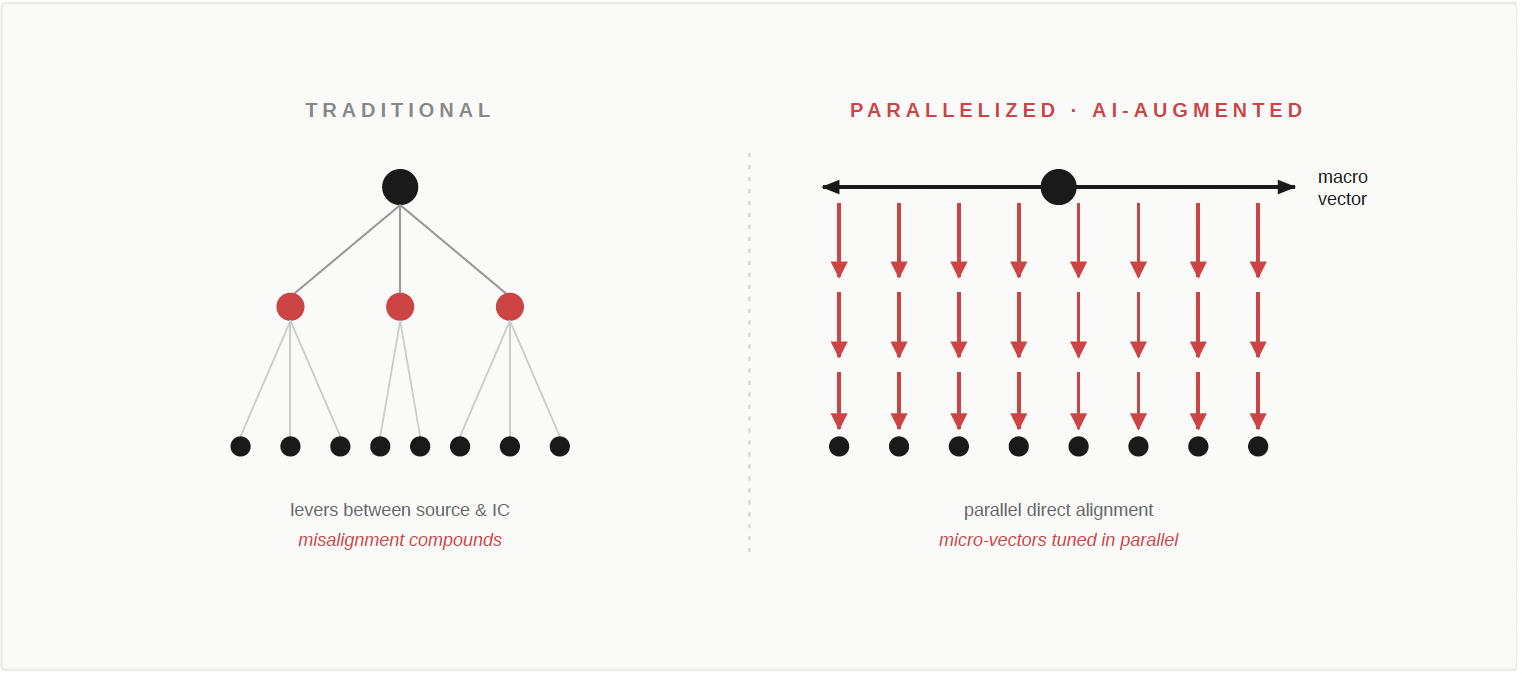
Each IC needs to know what to do next, and that next thing has to be vector-aligned. The AI carries the context. The top carries the vector. The layer in between is no longer required.
This is what we are doing at microagi. We have gone from 5 people to 80+ people and a corresponding amount of revenue growth only in a few months, with no traditional management layer. The speed is not an accident, and it is not a function of market timing. It is a direct consequence of how the company is built. We build incredible internal tools (some of which we will opensource soon) for everything, hence our calls to SaaS is dead. This allows us to move at the speed of tokens. Decisions travel from the top vector to the IC and back in minutes. Nothing is distorted on the way down. Nothing is filtered on the way up. The vectors stay aligned because there is nothing in between to misalign them.